Loading...
Emerging signaling pathways in toxicant-induced diseases
Tanvir Zaman Shoyshob
,Md Jamal Uddin
,Md. Abdul Hannan
Abstract
Toxicant exposure has emerged as a global health threat. Toxicant-induced diseases are associated with oxidative stress, inflammation, mitochondrial dysfunction, metabolic dysregulation, and regulated cell death pathways. Toxicants disrupt cellular homeostasis by activating interconnected signaling networks instead of targeting isolated molecular pathways like NF-κB, MAPKs, JAK/STAT, NRF2, HIF-1α, and p53. Recent studies also reveal emerging mechanisms, including ferroptosis, pyroptosis, necroptosis, cGAS-STING signaling, TRPM2-mediated Ca²⁺ dysregulation, ER stress, and SIRT1-dependent pathways that are central to toxicant-induced organ injury. These pathways contribute to various conditions such as neurotoxicity, chronic kidney disease, hepatotoxicity, cardiovascular complications, pulmonary fibrosis, immunotoxicity, and cancer. Additionally, systems biology and network toxicology approaches integrated with omics technologies are facilitating the mapping of dynamic toxicity networks and the identification of novel therapeutic targets. Overall, this review highlights the emerging signaling mechanisms involved in toxicant-related diseases and their potential for biomarker discovery and targeted therapies.
INTRODUCTION
Exposure to toxicants has become a significant global health issue. Toxicants, including heavy metals, pesticides, particulate matter, endocrine disruptors, microplastics, industrial solvents, and pharmaceutical residues, are linked to chronic diseases affecting vital organs such as the liver, kidneys, brain, heart, lungs, and immune system. Oxidative stress is regarded as a vital molecular response to toxicant exposure [1], and inflammation has become a key regulator of toxicant-induced pathology [2], [3]. While traditional toxicology has focused on direct cellular damage and oxidative stress, recent studies show that diseases caused by toxicants involve complex signaling pathways that regulate inflammation, metabolism, cellular stress responses, and programmed cell death [4].
Recent research has uncovered new signaling pathways. Ferroptosis, a regulated type of cell death dependent on iron and characterized by lipid peroxidation, has become a significant mechanism underlying toxicity from pollutants and injury in various organs [5]. Similarly, pyroptosis and necroptosis are gaining recognition as mechanisms involved in toxicant-induced inflammatory injury [5], [6]. Additionally, toxicants can induce endoplasmic reticulum (ER) stress and activate the unfolded protein response (UPR), thereby contributing to hepatotoxicity, neurodegeneration, and metabolic disorders by initiating apoptotic and inflammatory pathways [6].
A significant advance in toxicology research has recognized ion channels and metabolic regulators as key modulators of toxic injury. TRPM2-driven Ca²⁺ influx has been linked to oxidative stress-related damage in neuronal, cardiac, renal, and liver tissues caused by nanoparticles and neurotoxic substances [7]. Similarly, toxicants that suppress SIRT1 signaling worsen mitochondrial dysfunction, oxidative stress, and inflammation. These findings emphasize the complexity of diseases caused by toxicants, showing that various signaling pathways interact dynamically rather than functioning in isolation.
Recent advances in systems biology, network toxicology, and multi-omics technologies have revolutionized our understanding of toxicant-induced pathophysiology [8]. Combining transcriptomic, proteomic, metabolomic, and computational analyses now allows for the reconstruction of toxicity networks and the prediction of disease progression, ranging from inflammation to fibrosis and carcinogenesis [9]. These approaches offer opportunities to identify early biomarkers, new therapeutic targets, and strategies for precision toxicology. Consequently, understanding the emerging signaling pathways involved in toxicant-induced diseases is crucial for explaining disease mechanisms and creating targeted treatments. This review summarizes current knowledge on key and emerging signaling pathways linked to toxicant-induced diseases and explores their importance in contemporary toxicology research and therapy development.
TOXICANTS IN STRESS AND INFLAMMATORY SIGNALING
Oxidative stress has been suggested as a key molecular response to toxicant exposure [1]. Oxidative stress and overproduction of reactive oxygen species (ROS) are primarily triggers of many toxicants (heavy metals, paraquat, drugs) to damage via NF κB, NRF2, JAK STAT, MAPKs, FOXO, HIF-1α, and p53 pathways [6, 10-12].
Inflammatory signaling has become a crucial regulator of toxicant-induced pathology. MAPK pathways, including ERK, p38, and JNK, induce extracellular toxic signals leading to apoptosis, inflammation, and growth changes in the central nervous system (CNS), endothelium, kidney, liver, and lung [10, 11, 13]. NF-κB–NLRP3 inflammasome–cytokine axes drive toxicant-induced inflammation in sepsis, lungs, kidneys, and immune organs [2], [3], [11], [13].
Recent evidence emphasizes the significance of the cyclic GMP-AMP synthase-stimulator of interferon genes (cGAS-STING) pathway as a crucial DNA-sensing inflammatory mechanism involved in chronic kidney disease, pollutant-induced fibrosis, and chronic inflammatory disorders [13].
Furthermore, environmental pollutants induce various adverse effects in both the environment and human health, including inflammation, apoptosis, necrosis, pyroptosis, and autophagy. Recently, identification of ferroptosis as a regulator of programmed cell death has emerged as a critical mechanism of pollutant-induced toxicity [5]. Impacts of various toxicants on classic signaling pathways associated with organ dysfunction are presented in Table 1.
Table 1. Major toxicant‑induced emerging cell death programs and organ-specific pathways.
TOXICANTS IN EMERGING CELL DEATH PROGRAMS AND ORGAN-SPECIFIC PATHWAYS
Table 1 highlights the impacts of various toxicants on cell death processes and organ-specific signaling pathways.
Ferroptosis
Sepsis is a complex systemic disease. Systemic toxicity, arising from inflammation, oxidative stress, apoptosis, pyroptosis, and ferroptosis, leading to multi-organ injury. Pollutants such as fine particles, metals, and organics, and sepsis activate iron and lipid peroxidation–dependent cell death, which contributes to heart, lung, liver, kidney, and brain injury [2, 5]. A high-iron diet in a murine model induced ferroptosis, which was rescued by ferroptosis inhibitors [5].
Pyroptosis and necroptosis
Damage-associated molecular patterns (DAMPs) are released by damaged or injured cells. DAMPs and toxins engage NLRP3–caspase 1–GSDMD and necroptotic machinery in sepsis, pollutant, and pesticide toxicity. Human neuroblastoma cell lines (IMR-32 and SK-N-SH cells) treated with various concentrations of Bisphenol A (BPA) induced apoptosis as well as promoted pyroptosis [2, 5, 6, 11].
ER stress–UPR
Endoplasmic Reticulum (ER) stress is an accumulation of UPR proteins in the ER. Many hepatotoxicants (CCl₄, acetaminophen, solvents, cocaine, morphine) drive ER stress that transitions from adaptive UPR to apoptosis, necroptosis, ferroptosis, and pyroptosis. An overdose of acetaminophen in mice caused hepatocyte apoptosis and led to liver injury by ER stress [6].
TRPM2 mediated Ca²⁺ dysregulation
TRPM2-mediated Ca²⁺ dysregulation links diverse oxidative toxicants (amyloid β, MPTP, ischemia, nanoparticles, acetaminophen) to cell death in the brain, heart, kidney, liver, and pancreas. Many studies showed that neuronal death and brain injury were reduced by knocking out TRPM2 in a mouse model [7].
SIRT1 signaling
Toxicants often suppress SIRT1, worsening mitochondrial dysfunction, oxidative stress, and inflammation via targets such as PGC 1α, NF κB, and PPARs; SIRT1 activators can mitigate damage. Acetaminophen caused liver injury by suppressing SIRT1 activity in male Wistar rats. On the other hand, the activator of SIRT1 (resveratrol) protected the liver [18].
SYSTEMS BIOLOGY AND NETWORK TOXICOLOGY APPROACHES
Network and systems toxicology reconstructed dynamic “toxicity networks”, highlighting the role of NF κB, NLRP3, GPX4, and mitochondrial pathways in sepsis, chronic liver and kidney diseases [9, 13]. Network toxicology and molecular docking have been applied to plasticizers (ATBC, BPS) to identify core targets (AKT1, CASP3, EGFR, MAPK3) and enrichment in cancer and inflammatory pathways in the prediction of brain and prostate injury [16].
Further, integrated omics and AI based modelling helped forecast toxicant (e.g., cadmium–microplastics) driven transitions from inflammation to fibrosis and cancer (NAFLD to HCC) [2, 9].
CONCLUSIONS
Toxicant-induced diseases result from complex, interconnected signaling networks that involve oxidative stress, inflammation, mitochondrial dysfunction, ER stress, and regulated cell death pathways. Classical pathways such as NF-κB, MAPKs, and NRF2 continue to be central to toxic injury; however, emerging mechanisms, including ferroptosis, pyroptosis, necroptosis, cGAS–STING signaling, TRPM2-mediated Ca²⁺ dysregulation, and SIRT1 signaling, are expanding our understanding of toxicological mechanisms (Figure 1). These pathways contribute to various diseases, including neurodegeneration, chronic kidney disease, hepatotoxicity, cardiovascular problems, lung injury, immunotoxicity, and cancer. Notably, advances in systems toxicology, omics tools, and AI-based modeling have helped identify dynamic toxicity networks and new molecular targets. Future research focusing on pathway crosstalk, biomarker discovery, and mechanism-based therapeutics will be essential for improving risk assessment and developing targeted interventions against toxicant-related diseases.
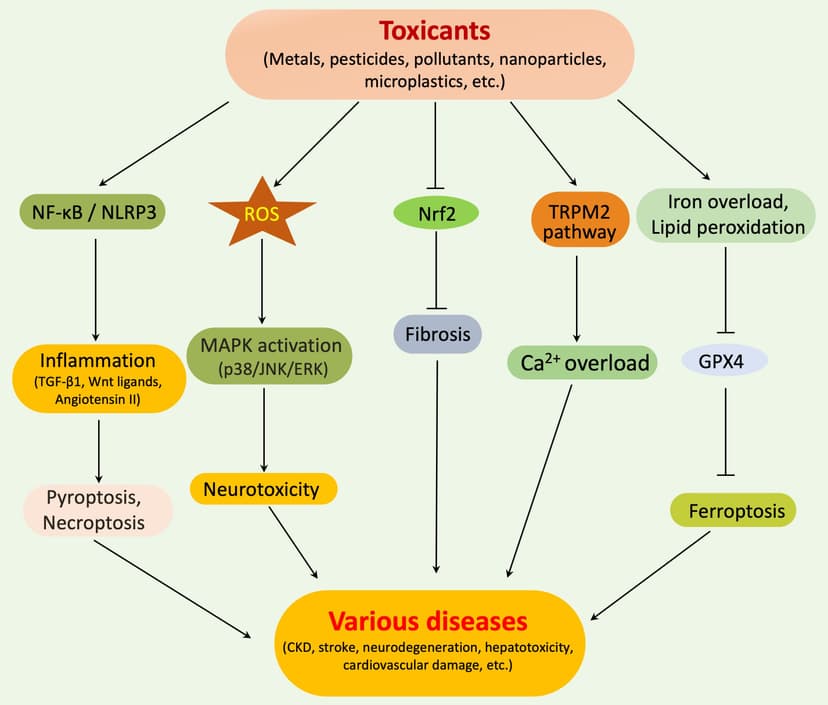
Figure 1. Toxicants (heavy metals, plastics, pesticides, pollutants, etc.)-induced emerging signaling pathways in various diseases, such as chronic kidney diseases (CKD), stroke, neurodegeneration, hepatotoxicity, cardiovascular dysfunction, etc. Classical pathways such as NF-κB, MAPKs, and NRF2 continue to be central to toxic injury; however, emerging mechanisms, including ferroptosis, pyroptosis, necroptosis, cGAS–STING signaling, TRPM2-mediated Ca²⁺ dysregulation, and SIRT1 signaling, are playing vital roles in toxicological mechanisms in various diseases.
ACKNOWLEDGEMENTS
None.
AUTHOR CONTRIBUTIONS
MJU designed outlines and drafted the manuscript. MJU, TZS, and MAH wrote the initial draft of the manuscript. MJU, TZS, and MAH reviewed the scientific contents described in the manuscript. All authors have read and agreed to the published version of the manuscript.
CONFLICTS OF INTEREST
There is no conflict of interest among the authors.
DECLARATION ON USING AI-ASSISTED TOOLS
During the preparation of this manuscript, the authors used artificial intelligence (AI) tools (such as Consensus) to improve readability and language quality. Following the use of technological supports, the author(s) reviewed and edited the text as required and take full responsibility for the text of the publication.
References
[1]
Sule RO, Rivera GD, et al. Environmental toxins and oxidative stress: The link to cardiovascular diseases. Antioxidants2025. p. 604.
[2]
Liu S, Liang Q. Sepsis toxicity network reconstruction—dynamic signaling and multi-organ injury: A review. Biomolecules and Biomedicine. 2026;26:262-73.
[3]
Zhang Y, Chen M, et al. Mechanistic insights into t-2 toxin-induced thymic epithelial cell injury and immunotoxicity via the ros-nf-κb-nlrp3 signaling axis. J Agric Food Chem. 2025;73:12961-77.
[4]
H, Liu B, et al. Mechanistic role of environmental toxicants in inducing cellular ferroptosis and its associated diseases. Ecotoxicology and Environmental Safety. 2025;298:118269.
[5]
Yang L, Cai X, et al. Ferroptosis induced by pollutants: An emerging mechanism in environmental toxicology. Environmental Science and Technology. 2024;58:2166-84.
[6]
Tak J, Kim SG. Effects of toxicants on endoplasmic reticulum stress and hepatic cell fate determination. Toxicological Research. 2023;39:533-47.
[7]
Malko P, Jiang LH. Trpm2 channel-mediated cell death: An important mechanism linking oxidative stress-inducing pathological factors to associated pathological conditions. Redox Biology. 2020;37.
[8]
Zhang X-R, Chen Y-H, et al. Integrated transcriptomics, metabolomics, network toxicology and phenotype-based validation unveil the ferroptosis-induced toxicity mechanism of methyl eugenol in zebrafish (danio rerio). Journal of Hazardous Materials Advances. 2026;22:101154.
[9]
Li Y, Jian Y, et al. Molecular regulatory networks of microplastics and cadmium mediated hepatotoxicity from nafld to tumorigenesis via integrated approaches. Ecotoxicology and Environmental Safety. 2025;300.
[10]
Ijomone OM, Iroegbu JD, et al. Impact of environmental toxicants on p38- and erk-mapk signaling pathways in the central nervous system. NeuroToxicology. 2021;86:166-71.
[11]
Liu X, Yang H, et al. Signaling pathways involved in paraquat-induced pulmonary toxicity: Molecular mechanisms and potential therapeutic drugs. Int Immunopharmacol. 2022;113.
[12]
Qu F, Zheng W. Cadmium exposure: Mechanisms and pathways of toxicity and implications for human health. Toxics. 2024;12.
[13]
Yuan Q, Tang B, et al. Signaling pathways of chronic kidney diseases, implications for therapeutics. Signal Transduction and Targeted Therapy. 2022;7.
[14]
Liu Y, Gong X, et al. Investigation of nickel sulfate-induced cytotoxicity and underlying toxicological mechanisms in human umbilical vein endothelial cells through oxidative stress, inflammation, apoptosis, and mapk signaling pathways. Environmental Toxicology. 2022;37:2058-71.
[15]
Huang S. Efficient analysis of toxicity and mechanisms of environmental pollutants with network toxicology and molecular docking strategy: Acetyl tributyl citrate as an example. Science of the Total Environment. 2023;905.
[16]
Huang S. A novel strategy for the study on molecular mechanism of prostate injury induced by 4,4′-sulfonyldiphenol based on network toxicology analysis. J Appl Toxicol. 2024;44:28-40.
[17]
Khanam M, Akter S, et al. Polybag-mediated microplastics in fruits and vegetables: Emerging global threat to health. Toxicant Research. 2025;1:07-18.
[18]
Ren Z, He H, et al. The role of different sirt1-mediated signaling pathways in toxic injury. Cellular and Molecular Biology Letters. 2019;24.
Share and Cite
Harvard Style
Shoyshob, T. and Uddin, M. and Hannan, M., 2026, 'Emerging signaling pathways in toxicant-induced diseases', Toxicant Research, vol. 2, no. 1, pp. 12-17.
ACS Style
Shoyshob, T.; Uddin, M.; Hannan, M. Emerging signaling pathways in toxicant-induced diseases. Toxicant Research 2026, 2(1), 12-17. https://doi.org/10.66439/tr.2026.02
AMA Style
Shoyshob, T.; Uddin, M.; Hannan, M. Emerging signaling pathways in toxicant-induced diseases. Toxicant Research. 2026;2(1):12-17. https://doi.org/10.66439/tr.2026.02
Chicago/Turabian Style
Shoyshob, Tanvir Zaman ; Uddin, Md Jamal; Hannan, Md. Abdul. 2026. "Emerging signaling pathways in toxicant-induced diseases" Toxicant Research 2, no. 1: 12-17. https://doi.org/10.66439/tr.2026.02
APA Style
Shoyshob, T.; Uddin, M.; Hannan, M. (2026). Emerging signaling pathways in toxicant-induced diseases. Toxicant Research, 2(1), 12-17. https://doi.org/10.66439/tr.2026.02
Article Metrics
Article Access Statistics
Article Info
Academic Editor
Md Niamul Haque, PhD
Received
01 February 2026
Accepted
24 March 2026
Published
28 March 2026
Article DOI
10.66439/tr.2026.02Corresponding Author
Md Jamal Uddin
,ABEx Bio-Research Center, East Azampur, Dhaka-1230, Bangladesh
;Email: hasan800920@gmail.com
Md. Abdul Hannan
,Department of Biochemistry and Molecular Biology, Bangladesh Agricultural University, Mymensingh-2202, Bangladesh
;Email: hannanbmb@bau.edu.bd
Cite this article
Shoyshob T, Uddin M, Hannan M. Emerging signaling pathways in toxicant-induced diseases. Toxicant Res. 2026; 2(1), 12-17. 2026; 2(1): 12-17